Why Madonna Figures Used Blue for Centuries and Where It Came From?
Color in religious art was never decorative. It was doctrinal. Every shade carried a specific meaning that worshippers across Europe recognized immediately, whether they could read or not. Of all the colors used in sacred art, none has a more fascinating and layered history than the blue worn by the Virgin Mary. This is the story of how a single color became the most recognized symbol in Christian iconography and why it still appears on Madonna figures carved in South Tyrolean workshops today.
A Color Reserved for the Divine
In the ancient world, blue was extraordinary, unlike red or yellow, which could be made from common earth pigments; true blue required rare and expensive sources. In the ancient Mediterranean world, blue dye came from a handful of plants and, in its most precious form, from a mineral called lapis lazuli.
Lapis lazuli was mined almost exclusively in the Badakhshan region of what is now Afghanistan. Getting it to European painters and sculptors required a trade route stretching thousands of miles. The finished pigment, called ultramarine, meaning literally "from beyond the sea," was worth more per gram than gold at various points in the medieval period.
This made blue the color of rarity, prestige, and the sacred. It was not used carelessly.
How the Church Chose Blue for Mary
The early church did not immediately dress Mary in blue. In the oldest known depictions from the Roman catacombs, Mary appears in dark red or purple, the colors of royalty and the imperial court. Blue entered the picture gradually, somewhere between the 6th and 9th centuries, as theological ideas about Mary's role deepened.
By the 11th and 12th centuries, blue had become firmly associated with heaven, with purity, and with the eternal. Mary, as the bridge between the human and divine, was given the color that expressed all three. The blue mantle became her signature.
The choice was also practical. Because ultramarine was so expensive, using it for Mary's robe was a deliberate statement of devotion. Patrons who commissioned religious art would specify in their contracts that Mary's mantle must be painted in ultramarine of the highest quality. Cutting costs on Mary's blue was considered disrespectful.
From Canvas to Carved Wood
From Painting to Sculpture Traditions
The color conventions of painting did not stay on flat surfaces. They moved into sculpture, into relief carving, and eventually into the tradition of carved and painted wooden figures that developed most fully in the Alpine regions of what is now South Tyrol.
The Role of Iconography in Carving
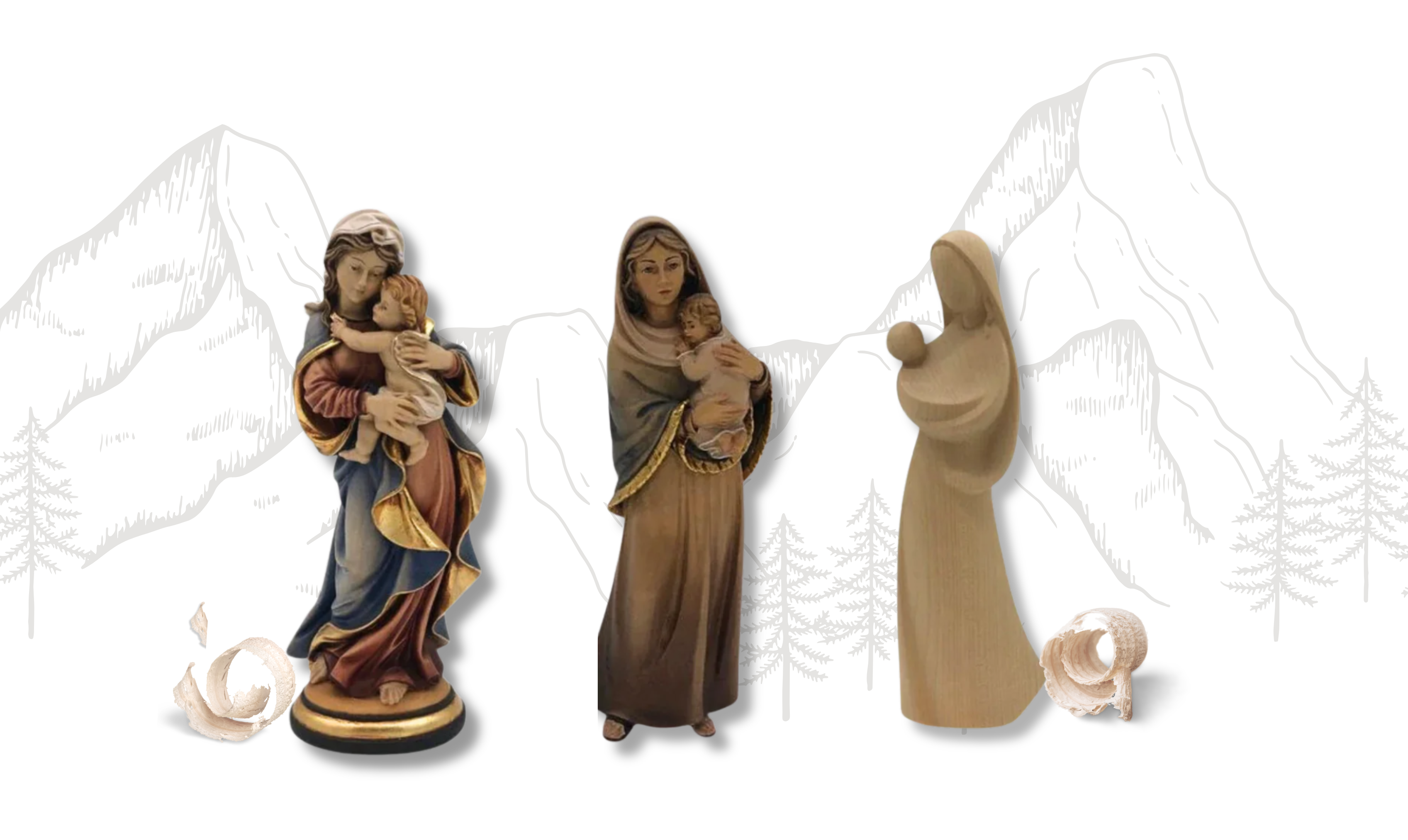
Carvers and painters working in the Grödnertal and surrounding valleys in the 17th and 18th centuries inherited these color rules directly from church iconography. When they carved a Madonna, the blue mantle was not a creative choice. It was a requirement, understood by every buyer who would place the figure in a home altar or a nativity scene.
A Tradition Preserved in South Tyrol
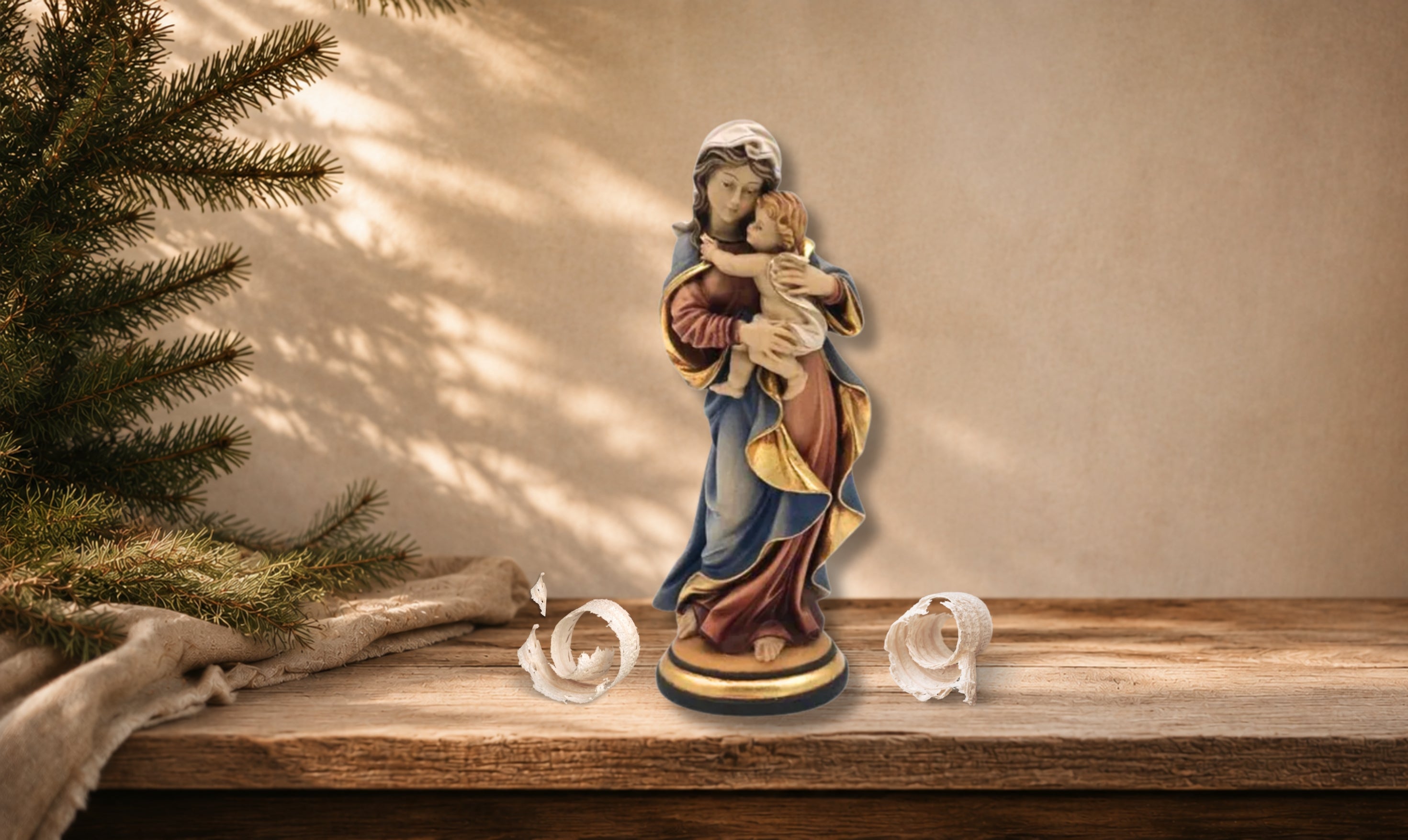
The tradition of painted wooden figures in South Tyrol carries this inheritance forward in an unbroken line. At Akantus, Madonna figures from the traditional South Tyrolean lines are still painted according to this color symbolism. The blue is not simply a paint choice. It connects every figure directly to a tradition that is over a thousand years old.
What Happened When Ultramarine Became Affordable
For centuries, only wealthy patrons could afford ultramarine. Parish churches in poorer regions used azurite, a cheaper blue mineral, or mixed other pigments to approximate the color. The result was visually similar but chemically different, and it aged differently, sometimes shifting toward green over time.
In 1826, a French chemist named Jean-Baptiste Guimet developed a synthetic version of ultramarine that could be produced at a fraction of the cost of the natural mineral. Suddenly, the blue that had been reserved for the Virgin Mary in the grandest cathedrals of Europe was available to any painter, any craftsman, any workshop.
This did not change the symbolism. It democratized it. More figures, more families, more homes could now display a Madonna in the proper blue. The meaning of the color remained intact. Only the barrier of cost was removed.
Blue in the Context of the Full Color Scheme
Understanding the blue of Mary requires seeing it within the full symbolic color system of sacred art. Each color had its role:
-
Blue: Heaven, eternity, purity, the divine nature of Mary's role
-
Red (beneath the blue mantle): Mary's humanity, her earthly nature, her participation in the suffering of Christ
-
White: Innocence, the Immaculate Conception
-
Gold: The presence of God, divine light, eternity
This layered system means that a well-made Madonna figure is not just an object. It is a compressed theological statement. Every color answers a question about who Mary is and what she represents.
For large nativity figures, this color system becomes even more important because the figures are seen from a greater distance. The colors must communicate clearly across a room. This is one reason why traditional South Tyrolean figures maintain such precise and saturated color choices, even in contemporary production.
Why the Tradition Persists Today
In an age when mass production can deliver any color at any cost, the choice to maintain traditional color symbolism on hand-painted wooden figures is a deliberate one. It is a choice to keep the figures connected to their meaning rather than treating them purely as decorative objects.
Workshops in South Tyrol, including those whose work Akantus carries, train their painters in this color language. A new painter does not simply choose colors that look attractive. They learn what each color means, why it appears where it does, and what would be lost if the convention were abandoned.
This is the difference between a craft tradition and a manufacturing process. One carries memory. The other does not.
FAQ
Why does Mary sometimes appear in black or dark clothing in older figures?
Dark or black robes appear in depictions of Mary in mourning, particularly in Pietà scenes. Black represented grief, which is why it was used specifically in scenes of Christ's death rather than in nativity or coronation scenes.
Are all the blue pigments used on old figures the same?
No. Ultramarine, azurite, smalt, and indigo were all used at different periods and price points. Each ages differently. On very old figures, what was once bright blue may have shifted toward grey or green depending on the pigment used.
Do modern hand-painted Madonna figures still follow the traditional color rules?
In quality workshops, they do. Figures produced by the traditional South Tyrolean workshops carried by Akantus follow the historical color symbolism closely, both as a mark of authenticity and as a commitment to the meaning that makes these figures more than decoration.