Why Has the Wooden Madonna Been a Symbol of Protection and Shelter for Centuries?
Few figures in European art history are as enduring as the Madonna. Across centuries and through shifting eras and stylistic movements, craftspeople return to her again and again. This is not coincidental. The wooden Madonna possesses a quality that partly resists rational explanation - but that anyone feels when standing before a well-carved figure.
What makes her so enduring? What allows her to remain relevant across theological boundaries and generations? The answer lies both in the content of the representation and in the material that carries it.
The Madonna as the Archetype of Human Protection
The image of a mother holding, sheltering, or smiling at her child is archetypal. It lies deeper than any religion, deeper than any cultural tradition. It speaks to what has moved people of all times: the experience of protection, of belonging, of another person who stands up for you.
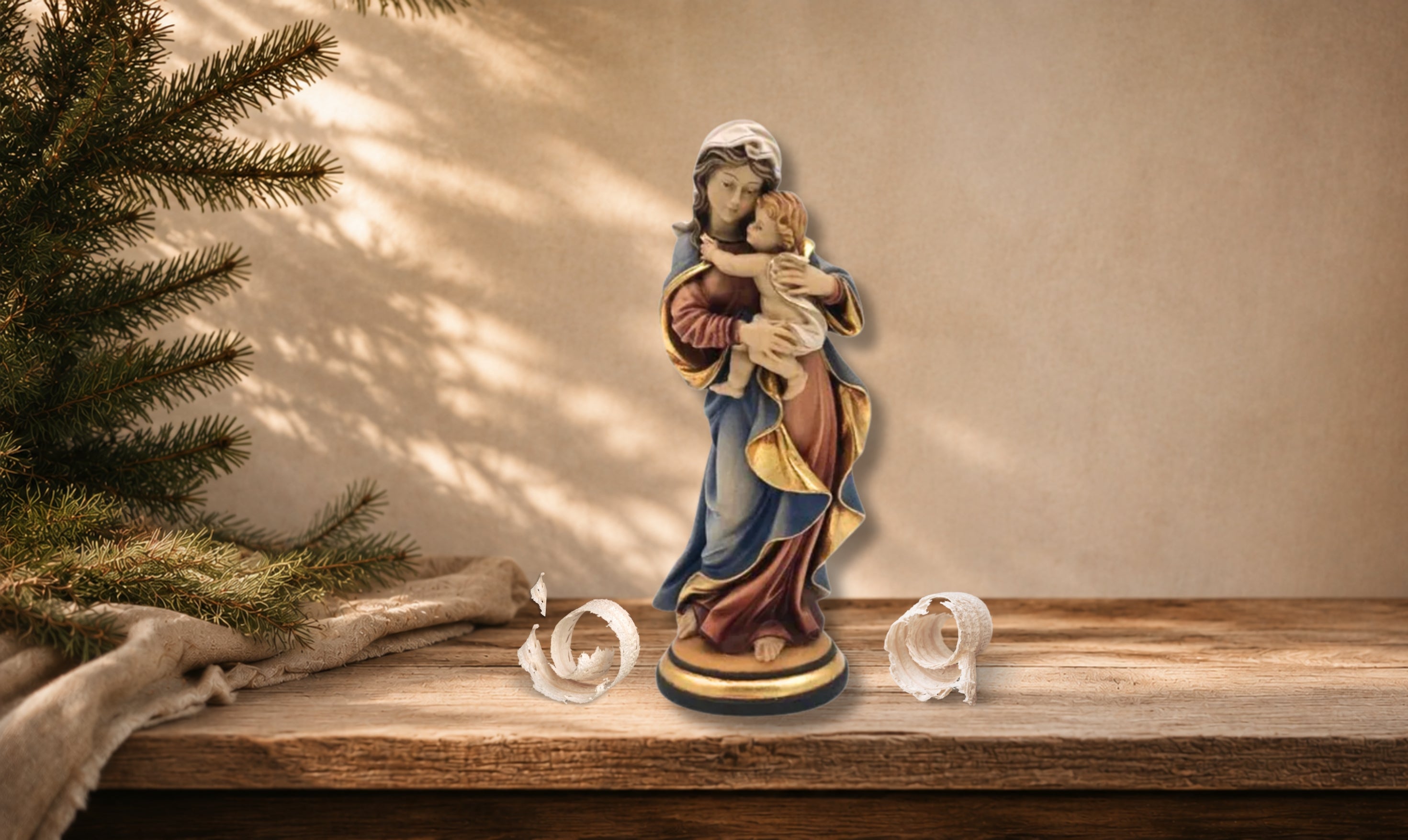
The wooden Madonna from South Tyrol carries this meaning in every detail. The tilt of the head is not upright, but leaning slightly toward the child. The position of the hands - open, sheltering, receiving. The facial expression - calm, not sentimental. All of this is the result of a centuries-old visual language passed from carver to carver.
Wood as the Material of the People
Why wood, and not stone or metal? The answer is less technical than cultural:
-
Stone was the material of cathedrals and institutions - grand, permanent, but distant. It belonged to the powerful, to the church, to authority. Ordinary people did not carve their devotion in stone.
-
Metal was precious and rare. It required specialist tools, specialist knowledge, and a level of wealth that most households did not have. A metal Madonna was a luxury object - admired, perhaps, but not lived with.
-
Wood was different. It grew in every forest, was worked in every village, and shaped by hands that also built furniture, repaired barns, and carved tools. It was the material of daily life.
This is why a marble Madonna stood in the cathedral - elevated, untouchable, formal. A wooden Madonna belonged somewhere else entirely:
-
In the parlour, where the family gathered in the evenings
-
At the door frame, greeting everyone who entered and left
-
On the windowsill in the bedroom, present through the night
-
In the workshop, watching over the craftsman at his bench
She was tangible. She was close. In South Tyrol, it was understood across generations that a carved Madonna had her place in every home - not as a work of art to be admired from a distance, but as a companion woven into daily life.
Wood also ages in a way that no other material quite matches:
-
A marble figure stays the same - cool, flawless, unchanged - but also unmoved
-
A metal object tarnishes and corrodes unless carefully maintained
-
A wooden figure, by contrast, develops a patina over the years - a deepening of tone, a softening of surface, a visible record of the time it has spent in a home
This patina is not damaged. It is evidence. A well-cared-for wooden Madonna from a century ago carries the warmth of every room it has stood in, every winter it has seen, every family that has kept it close. It does not look old - it looks lived-in. And that gives it a credibility that a newly made figure, however skillfully crafted, simply cannot replicate.
The Craftsmanship Behind Every Figure
A high-quality wooden Madonna figure is not created quickly. The carver begins by selecting the right piece of wood - at Akantus, this is sycamore from South Tyrol, finely grained, evenly grown, with a density that allows precise carving. Then comes the forming: broad strokes that release the volume, followed by increasingly fine work that brings face, robe, and hands into being.
What follows is the painting, and this step can hardly be overestimated in its significance. Having painted wooden figures at Akantus is not a subsequent refinement but an independent act of design. Every fold in the robe gains depth through gradations of colour. The face receives warmth through carefully placed tones. The hands come alive through subtle shading.
It is these painted details that distinguish a wooden figure from a blank. They are the moments when carved wood becomes a personality.
Mary in the Nativity Scene: More Than a Figure
In the nativity scene, Mary is not a secondary figure. She is the focal point of the scene. The way she holds the child, how she looks down at it, how she relates to Joseph and to the other figures - all of this constitutes the scene as a story.
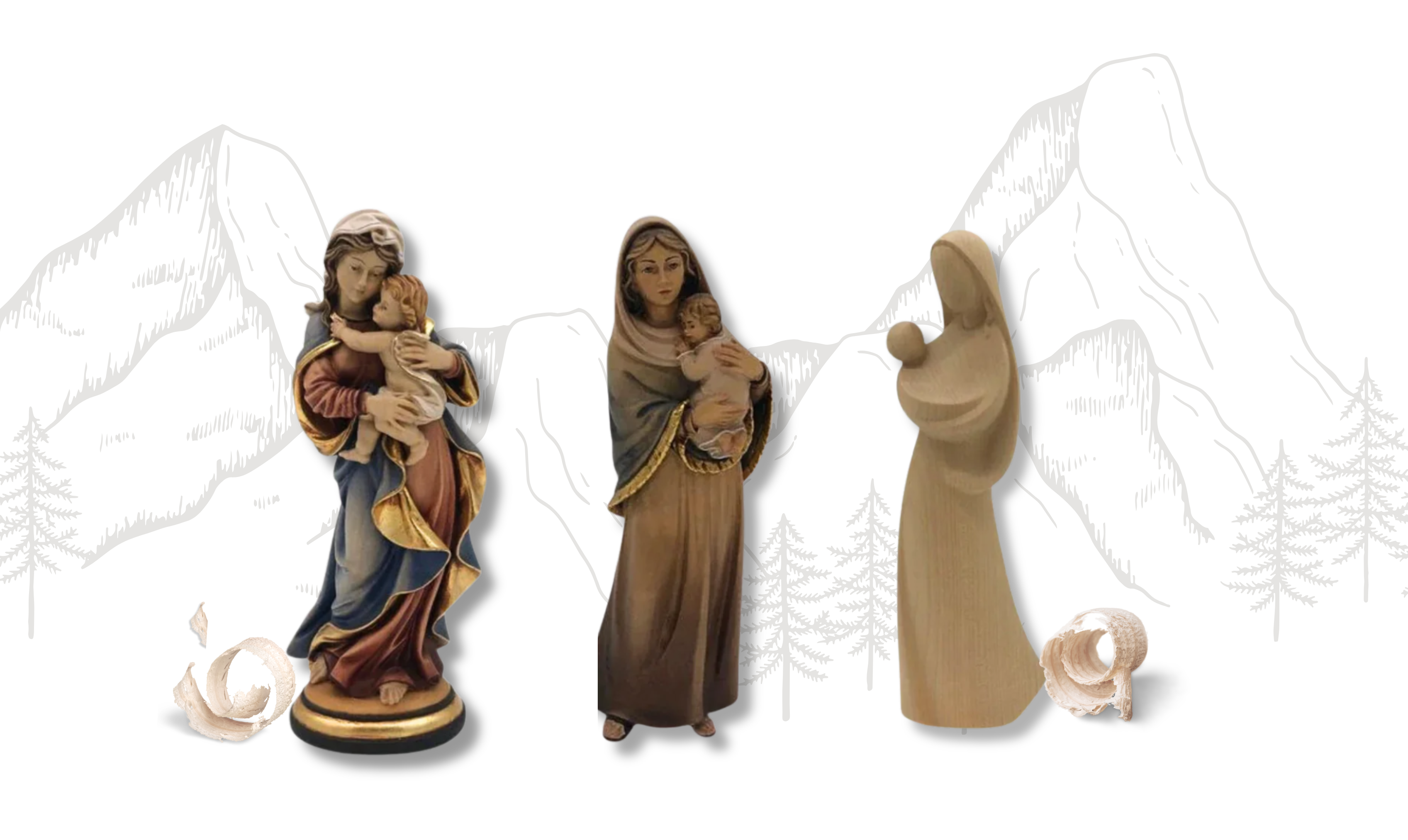
Akantus offers Mary figures across various series, from the classic Kostner nativity to modern variants. All are made from the same base material - sycamore from South Tyrol - and all are hand-painted. The differences lie in style: the Kostner Mary is naturalistic, with fine anatomical detail. The modern variants are more reduced in form, but no less expressive.
Protection and Shelter as an Enduring Message
Why has the Madonna been a symbol of protection for centuries? Not because it was decreed, but because people have always recognised the same thing in her. A mother who does not let go. A gesture that shelters even when no words are spoken. A gaze that says: here you are safe.
This message is independent of era and style. A rural carving from the 17th century carries it just as much as a carefully painted figure from the Akantus workshop. The wood is the carrier - the meaning lies in what speaks through that wood.
And that is perhaps the secret of the wooden Madonna: wood is warm. It is the warmest material a carver has. And a figure meant to express protection and shelter should be warm, in the literal and the figurative sense.
FAQ
What distinguishes a wooden Madonna from one made of artificial stone or ceramic?
Wood gives the figure an organic warmth and a fine carveability that other materials cannot achieve. It ages with dignity and develops a patina that increases the value of the piece over the years. Artificial stone and ceramic are colder in expression and more susceptible to breakage.
How do you properly care for a hand-painted wooden figure?
Store in dry conditions and avoid direct sunlight. Never wipe with a damp cloth - moisture attacks the paint. For dust, a soft dry cloth is sufficient. Aggressive cleaning products permanently damage the surface.
Can a wooden Madonna figure be displayed independently of the nativity scene?
Yes, and this is a widespread tradition. In South Tyrol, the Madonna frequently stood as a standalone figure in the entrance hall, on the mantelpiece, or in the bedroom. She was present throughout the year, not only at Christmas time.